Conrad Frankel
Roman Lamp with Butterchurch and Fruit
A closer look by James Mason, intern at Olivier Cornet Gallery
In September 2026, James Mason, intern at Olivier Cornet Gallery, wrote about Conrad Frankel's 'Roman Lamp with Butterchurch and Fruit, oil on linen laid on wood, 30x40cm, available to purchase for 2,500.00 Euro.
Conrad Frankel’s fifth solo show at the Olivier Cornet Gallery ‘Silent Light’ created a beautiful space, promoting reflection and contemplation.
As he stated, the show did not carry any explicit meaning or message. It aimed to do the opposite, where the gallery could operate as a space that forgets the chaos and turbulence of our current times and instead, offer a place to focus on form, texture and silence in everyday objects and visuals – past and present. Nevertheless, the space operates in such a way that interpretation is assigned to or associated with these works. It invites a close looking that reflects on the history of still life painting and aesthetics.
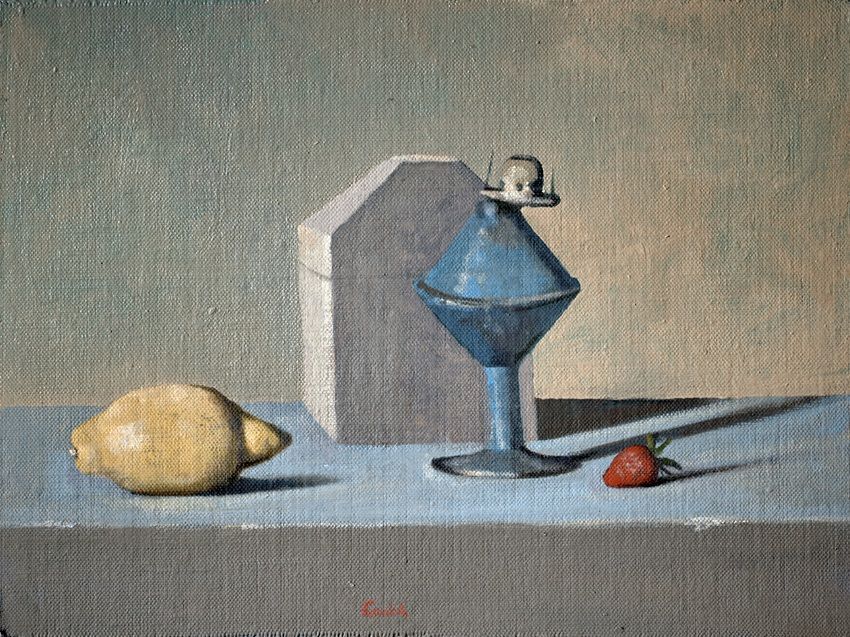
Looking at the archives of this picturesque show, I am particularly drawn to the 'Roman Lamp with Butterchurch and Fruit', oil on linen laid on wood, 30x40cm. The composition and texture of the piece display a delicate balance of colour, depth, dimension and form. In many ways, it evokes a feeling or sensation that feels antiquated in our contemporary world.
The azure blue of the Roman lamp seamlessly complements the citrus yellow of the lemon, meanwhile the crimson red in the strawberry helps render a visual harmony across the picture plane. To the rear, the butterchurch anchors the composition, helping to accentuate the sense of depth and shadow across the scene.
Looking at this work, I feel the silence projected through this simple composition. As the objects stand dignified and noble, they echo a halcyon of bygone times, invoking the still life paintings of the seventeenth century. Conrad’s 'Roman Lamp with Butterchurch and Fruit' continues in a rich tradition that names some of the great masters of art history and still life painting, from Caravaggio and his use of chiaroscuro, Peeters, with her depth and dimensionality, and Cézanne’s richly constructed colour palette (to name just a few). In this light, Conrad’s 'Roman Lamp with Butterchurch and Fruit' are positioned in a history that translates the past and present, using everyday objects and motifs to create a simple, yet delicate visual synthesis. Their motifs help to demonstrate a silent, age-old essence which also speaks to the exhibition title ‘Silent Light’.
While this painting captivates my attention aesthetically, it has also illuminated my understanding of the objects and their function. Through the title, I have come to understand what exactly a Roman lamp is. It is an oil lamp that uses olive oil to burn on a wick, mass produced in the ancient world as a source of light. Nevertheless, learning about these simple objects has further animated my interest in the simplicity and nobility of Conrad’s work. Being able to understand their history, function and domestic value further echoes the serenity of the past translated into our tumultuous present.
Research Ireland Postdoctoral fellow in French at Trinity College Dublin, Max McGuinness, attended the opening of the exhibition as a guest speaker. He offered some words upon the exhibition, while setting it within Conrad’s wider oeuvre. What struck me was the red that Max mentions in the portrait by Conrad, that he sat for as a teenager. Max talks of the red that took over, one ‘worthy of Hogarth’. This same red resonates with me in the strawberry, situated next to the calm blues and muted yellows.
Looking at the work, I am drawn to the term ‘still life’. What is a still life and how is it captured? Upon this thought, it is reflected through the dichotomy of past and present. Conrad’s 'Roman Lamp with Butterchurch and Fruit' bring forward contexts that construct our past and present. It allows us to stop and take a moment to appreciate the aesthetic quality and beauty in many otherwise functional or practical items. For this work, what I find poignant is the obsolete nature of these historical objects. They call into question the passage of time and context of the present.
Conrad Frankel’s 'Roman Lamp with Butterchurch and Fruit' demonstrates how the past is animated in the present. A stillness of life is captured and rendered against a wider historical frame, bestowing a sense of peace and serenity. It invites its viewer to engage in its form, its raw materiality, colour, and texture. We are confronted with a past that is made physically present in our contemporary world, transforming the still life from a historical genre into a living one.
James Mason, 8 September 2026