Favourite artworks at Olivier Cornet Gallery in 2025
"When I first discovered the gallery’s storage area, many works caught my eye, but none like..."
Each year, with our initiative 'My Favourite artwork at Olivier Cornet Gallery, interns and volunteers take a closer look at artworks from the gallery’s stockroom and reflect on the pieces that spoke most strongly to them.
Six members of team OCG in 2025, namely Enrico Geremia, Lajla Dizdar, Louis-Jean Vannoye, Servane Peffer, Camille Lisonbee and Abi Keogh — share their favourite work and what it revealed to them in the process.
Enrico Geremia reflects on Shadows on Soil (Fall Irregardless) by Bart O’Reilly, a small acrylic painting whose soft stains on raw canvas evoke natural processes and a sense of suspended time. Drawing on the artist’s background and a poem connected to the work, Geremia explores how abstraction can feel both intimate and expansive, inviting viewers to inhabit their own interpretations.
Lajla Dizdar writes about Dunes, Sea Bindweed and Dunes, Sea Holly by Yanny Petters, captivated by the artist’s use of the rare verre églomisé (reverse painting on glass) technique. She highlights how the deep black backgrounds make the botanical forms glow with life, from the organic, twisting vines of the bindweed to the vertical strength of the sea holly, deepening her appreciation for nature’s overlooked beauty.
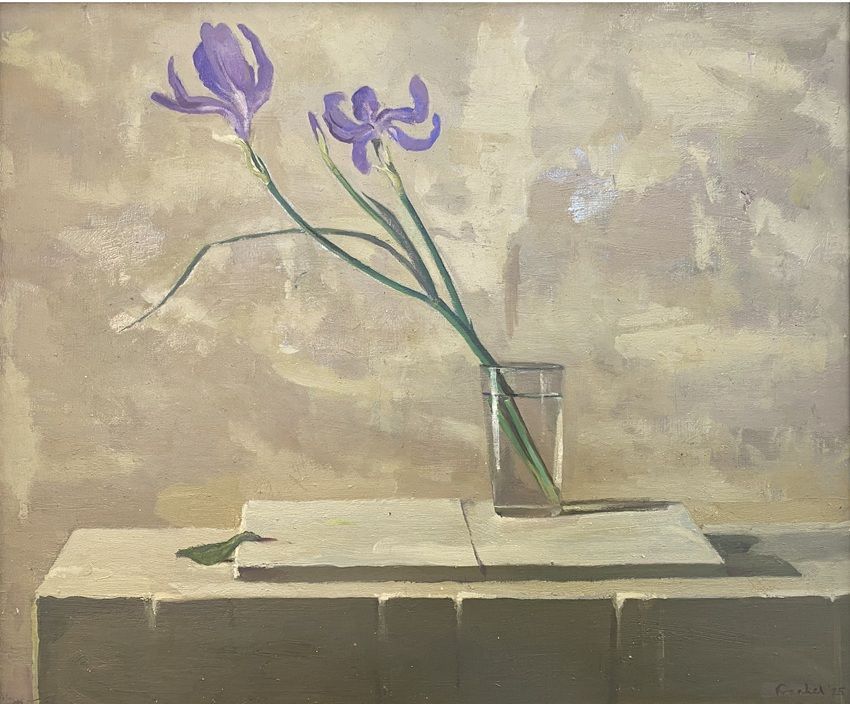
Louis-Jean Vannoye focuses on Irises by Conrad Frankel, drawn to the way the vibrant oil painting balances fragility and resilience. He highlights the artwork’s rich visual details — from the light refracting through the glass of water to the textured background — and interprets the irises’ posture and colour as symbols of life emerging in challenging surroundings, reflecting on themes of cyclicality, strength and rebirth.
Servane Peffer shares her response to Sumud by Eoin Mac Lochlainn, a charcoal and watercolour work that initially attracted her with its striking colours but ultimately moved her through its emotional depth and human resonance. She reflects on how Sumud is part of the artist’s broader project remembering lives affected by conflict and how the blurred, expressive face in the work stirred empathy, sadness and compassion — underscoring art’s power to evoke deep feeling and connection.
Camille Lisonbee considers A Cypriot story of displacement by Miriam McConnon, describing how the work’s layered interplay of image and text distills the artist’s personal and historical narratives of displacement. Lisonbee notes how the subtle combination of portraiture, map fragments and handwritten script creates space for reflection on memory, belonging, movement and loss — a poignant meditation on identity shaped by place and experience.
Abi Keogh responds to Peter’s Armour by Miriam McConnon with a focus on storytelling, empathy and lived experience. Keogh discusses how the imagined “armour” in this oil painting was built from objects brought by a young man forced to flee his home in Famagusta, Cyprus, and how the work gives voice to his history of displacement. Through this visual representation of personal belongings, the piece reinforces the enduring relevance of narratives of forced migration and human resilience.
The Olivier Cornet Gallery would like to take this opportunity to thank all our interns and volunteers for their excellent contribution to the gallery's dynamics during their time with us.
Image: Conrad Frankel, Irises, oil on linen on board, 34x41cm