Mary A. Fitzgerald
'Stella'
A closer look by Megan Hanlon, volunteer at Olivier Cornet Gallery
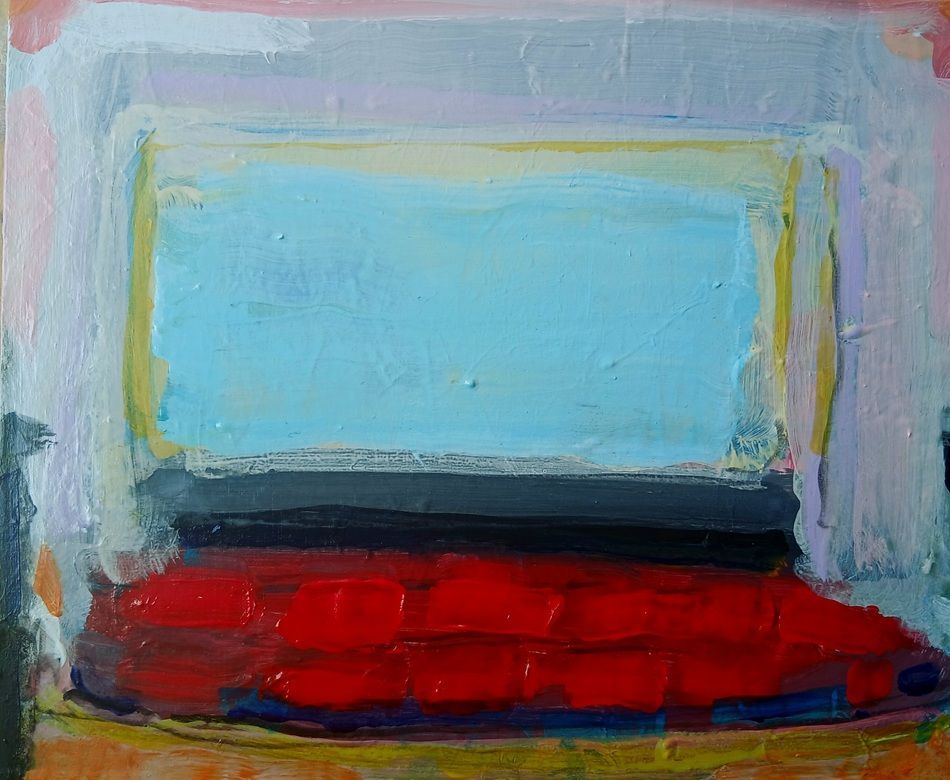
At the end of March 2026, Megan Hanlon, volunteer at Olivier Cornet Gallery, wrote about Stella by Mary A. Fitzgerald, acrylic on board, 24 x 30 cm, available to purchase for 675 euro.
In Stella, Mary A. Fitzgerald
presents an image which lingers between familiarity and uncertainty. Depicted through her characteristic use of bright hues with varying opacity, this painting transforms the recognisable image of the Stella Cinema through colour, offering a contemporary dream-like perspective which prompts reflection on nostalgia and human experience.
As demonstrated in much of Fitzgerald’s work, this painting draws on fragments of observation, splintered through memory and the passage of time. It evokes a sense of place, yet centres the experience of the space rather than the mere depiction of it. The artist’s background in printmaking is evident in the surface of the painting, where the image is built up in a series of layers which create a depth that is both visual and metaphorical.
The Stella Cinema itself is a Dublin institution with its own rich and shifting history. First opened in 1923 as an opulent art deco picturehouse, the venue has been endlessly altered across decades before its restoration in 2015. Fitzgerald’s Stella carries with it a sense of shifting time, distilled into one single image. Fragments of the cinema’s past, from its early glamour to its decline and reinvention, are echoed in the loose and ethereal brushwork of the piece.
The painting is both joyous and melancholic, the glowing colour evoking the moment in which the credits roll at the end of a classic technicolour film. The chosen perspective of the painting situates the viewer within the scene, overlooking the film screen and empty auditorium from the balcony. The loosely-discerneable architecture of the cinema is rendered secondary to the atmosphere itself, with the grandeur of the space communicated not through detail or ornamentation, but through rich, layered colour.
The painting captures a sense of both movement and stillness, as though the film continues to run long after the audience have filtered out. The absence of human presence transforms the cinema from a bustling site of cultural exchange to a haunting liminal space, where echoes of the past still linger in every corner. Even divorced from the cultural and historical context of its namesake, this painting captures a universal, bittersweet experience: the moment after the film has ended, the quiet after the party, the feeling of waking up with the television still on.
In this way, the painting moves beyond the depiction of a local cinema beloved by generations, becoming a mediation on the passage of time and the emotional weight of nostalgia. It invites the viewer to dwell in the in-between, and to reflect on the ways in which memory is informed not only by experience, but also by absence.
Stella was exhibited as part of the 2025 Out of Lines group exhibition held between June and August at the Olivier Cornet Gallery. Marking the 100th anniversary of the birth of art deco, this show featured artists’ explorations of art deco within the architectural landscape of Dublin City. This exhibition was part of the official Bloomsday programme for 2025, celebrating the time period in which Joyce’s beloved work, Ulysses, is set.
Megan Hanlon, 25 March 2026