
Miriam McConnon
Non Conforming Chairs
A closer look by James Mason, intern at Olivier Cornet Gallery
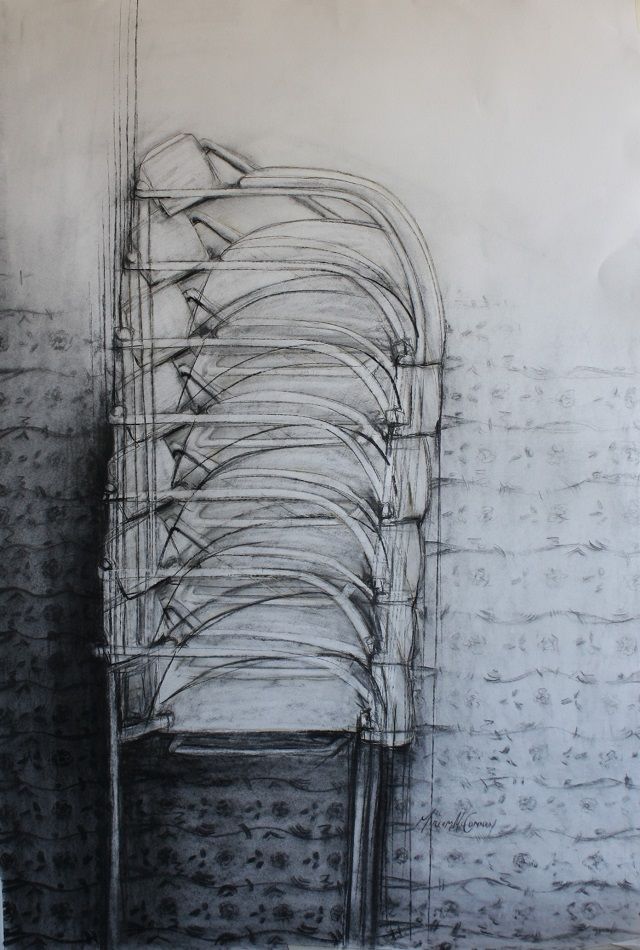
In early September 2026, James Mason, intern at Olivier Cornet Gallery, wrote about Miriam McConnon's Non Conforming Chairs, 2025, available to purchase for 1,500.00 Euro.
What We Can’t See In What We Can See
Miriam McConnon’s Non-Conforming Chairs - after Eileen Gray (2025) reflects on The Non-Conformist Chair (1926), a formative piece in the oeuvre of Eileen Gray and exemplary work in the history of Irish modernism and international furniture design. In her chair, Eileen eliminates the symmetry of the conventional armchair, rethinking its tubular structure and adapting it to the inclinations of the human body, allowing the body to rest to one side. In this sense, the chair adapts to the natural movement and physicality of the human form.
This adaptation of form and movement extends to Miriam’s 2025 work, featured in the November-December 2025 exhibition, titled, Ode to Giants. This exhibition focussed on the tributes and legacies of icons in art history, giants who played an intrinsic role in shaping both Irish heritage and international art. At first glance, we are met with the stationary chair, only to find it multiplied and extended vertically along the picture plane in a chronophotographic visual effect. It is this transformation of a static object into a dynamic rendering of movement, that draws me to Miriam’s work.
Looking beyond the chair itself, the background cuts across the vertical composition with a design reminiscent of Eileen’s early lacquer work (1910-1920). In referencing the early work, next to one of her most influential designs, Miriam pays homage to the theme of the 2025 exhibition. The charcoal medium that she uses, works from rich opacity in the bottom left corner towards an abstract transparency at the opposing corner. Visually, this dramatic effect helps to accentuate the dynamism and motion of the Non-Conforming chairs. However, conceptually, this effect also helps to emphasise the idea of what we cannot see in what we can see. The lacquer work motif moves from visible into the abstract, perpendicular to that of the chair.
Miriam brings to life the dynamics and materiality of Eileen’s static, non-conforming chair. Here the invisible becomes visible. We are presented with what we cannot see in what we can see. Eileen’s object extends beyond mere physicality, occupying not only space, but rather, time and movement on the two-dimensional plane.
This multiplicity resonates particularly with the chronophotographic experiments of Étienne-Jules Marey(1830-1904), a French scientist and physiologist noted for his studies of movement and dynamics. Marey’s work sought to reveal what we cannot see in what we can see, the passage of time and movement not visible to the naked eye. In this light, I find his ‘Analysis of The Flight of a Pigeon’ (1883-87) to conjure up the same sensations present in Miriam’s work. Both highlight what is not visible in something visible, capturing my interest in that regard.
Miriam transforms Eileen’s Non-Conformist Chair from a static object into an extended temporal reality rendering time, movement and perception beyond a conforming plane. Eileen’s functional object becomes unconventional; Miriam extends this concept one step further to render it non-conforming in a temporal sense. Like Marey’s images, we can see something beyond the naked eye in Miriam McConnon’s Non-Conforming Chairs -after Eileen Gray.
James Mason, 1 September 2026