Vicky Smith
'Self portrait with an Iron in a Hydrangea Garden'
A closer look by Carly O'Rourke, volunteer at Olivier Cornet Gallery
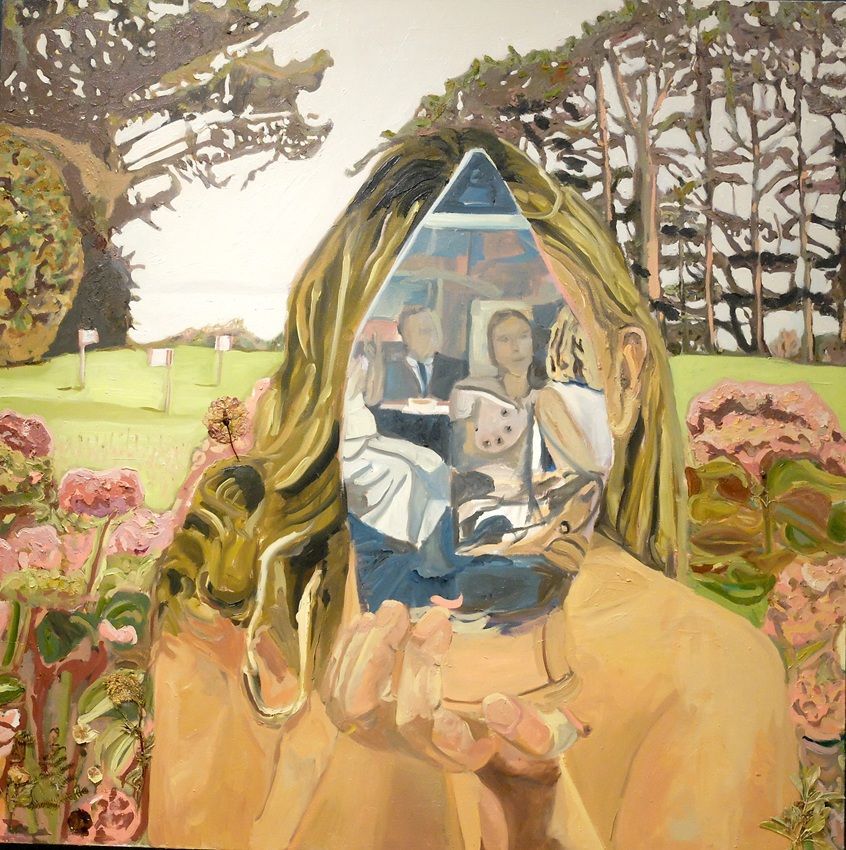
In early April 2026, Carly O'Rourke, volunteer at Olivier Cornet Gallery, wrote about Vicky Smith's Self-portrait with an Iron in a Hydrangea Garden, 2022, oil, acrylic and flowers on canvas, 132x132cm. Available for 3,500.00 Euro.
Painted in 2022, within the first four years of motherhood, Vicky Smith’s ‘Self-Portrait with an Iron in a Hydrangea Garden’ is part of the artist's solo exhibition Gairdín Rós | Rose Garden
running at the Olivier Cornet Gallery from the 8th of March until the 12th of April 2026. Created using oil, acrylic and flowers on canvas, this work is one of fourteen in a show that reflects on Smith's lived experience of negotiating her identity as both a mother and artist. Across a series of installation pieces and self-portraits, the artist ultimately presents an image of motherhood as a state of mind that is not incompatible with creativity. ‘Self-Portrait with an Iron in a Hydrangea Garden’ exemplifies this core theme, whilst also showcasing the complexities involved in Smith's balancing act.
Measuring at 132 x 132 cm, Smith’s self-portrait commands the viewer’s attention almost instantly. The establishment of a visual dialogue is further emphasised by the close proximity of Smith’s own figure to the picture plane. In holding out the iron towards the spectator, this collapses the visual barrier between subject and viewer. As a result, the audience is drawn in, thus carefully observing the various details of Smith’s thought provoking visual narrative. For example, in the bottom left and right hand corners of the hydrangea garden, Smith has applied real flowers to the canvas, granting the work a three dimensional quality. This effect of creating texture is carried across the work through the artist’s use of thick and painterly brush strokes when depicting the hydrangeas and trees.
The background itself holds significance for the artist, with Smith recreating an inherited photograph of a golf course bordered by Scots pines where her father and grandfather once played. Smith’s incorporation of this family memento into the pictorial scape adds an increasingly personal dimension to the painting. The golf course setting, which perhaps initially appears obscure, ultimately sheds light on Smith’s meaningful engagement with the sources of inspiration that she finds in her life.
Key to this work, Smith’s centering and presentation of her own self-image in the middle foreground communicates the theme at hand. The artist’s choice to depict herself in the nude form simultaneously projects both a sense of vulnerability and empowerment. In physically presenting the most bare version of herself, Smith metaphorically creates a blank canvas upon which to explore her identity. One facet to this identity is the role of mother and homemaker, as is indicated by the iron. The domestic expectations that are often placed on women by society have the capacity to be all-consuming, leaving little room for individuality. Smith demonstrates this predicament in a surrealist manner as her painted form partially merges with the iron. The iron’s bottom section is depicted in the same flesh tones as the artist’s skin, and its cord almost doubles as a strand of Smith’s hair. However, as per the theme of this exhibition, Smith appears to halt this metamorphosis to reinforce her identity as an artist. The image featured on the iron depicts the wives of astronauts - a subject that Smith has previously explored in her artwork. Throughout the history of space exploration, astronauts have been championed as heroes whilst their wives who were left behind to raise children and maintain domestic responsibilities were ignored. By confronting the viewer with this image, Smith honours these forgotten women for their sacrifice. Furthermore, by reclaiming the iron for her own artistic agenda, Smith reinforces that she is challenging the societal perception that a woman must choose between being a domestic goddess or an individual with creative ambition.
I was drawn to ‘Self-portrait with an Iron in a Hydrangea Garden’ as it is not just an aesthetically pleasing painting that showcases Smith’s skill in the areas of colour and texture. This work importantly demonstrates the artist’s talent for storytelling and representing a universal dilemma faced by women everyday. Whilst the viewer cannot see Smith’s face, they ultimately depart with a better understanding of her dual sense of self as both a mother and artist - two identities that she successfully highlights are in fact compatible.
Carly O'Rourke, 5 April 2026
Carly O'Rourke, 5 April 2026